
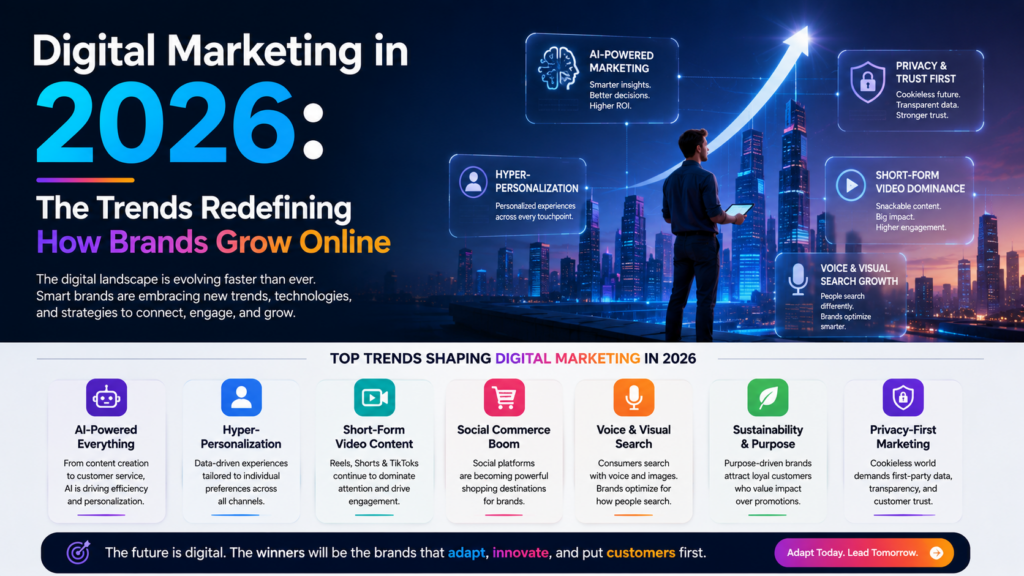
Digital marketing doesn’t stand still, and 2026 has already proven that the pace of change is only accelerating. Between AI reshaping how content gets created and discovered, shifting consumer trust, and new ways people search for and buy products, businesses that don’t adapt risk becoming invisible.
As a digital marketing agency, we’re constantly tracking these shifts so our strategies stay ahead of the curve not behind it. Here’s what’s actually shaping digital marketing in 2026, and what it means for your business.
1. AI Is Now a Strategic Layer, Not Just a Tool
AI has moved beyond simple automation. It’s now embedded across content creation, campaign optimization, audience targeting, and performance analysis. Marketing teams are using AI to analyze behavior patterns, generate content variations, and adjust campaigns in real time.
This shift is changing what it means to be a marketer. The value today isn’t in simply using AI tools it’s in knowing how to direct them strategically, interpret the data they produce, and make smarter decisions faster than competitors.
What this means for your business: Brands that treat AI as a strategic partner not a replacement for strategy — will out-execute those who don’t.
2. Personalization Is No Longer Optional
Consumers increasingly expect content, offers, and experiences tailored specifically to them. Generic, one-size-fits-all campaigns are losing effectiveness as audiences gravitate toward brands that understand their needs on an individual level.
What this means for your business: Segmented email campaigns, dynamic website content, and personalized ad targeting aren’t “nice to haves” anymore they’re baseline expectations.
3. Agentic AI Is Automating Campaign Execution
Beyond content generation, a new wave of autonomous AI systems is capable of making multi-step marketing decisions and executing complex campaign workflows with minimal human input — from bid adjustments to audience refinement.
What this means for your business: Agencies and in-house teams who adopt agentic AI tools can move faster and more efficiently, freeing up strategists to focus on big-picture growth instead of manual execution.
4. Search Behavior Is Fragmenting Beyond Google
Search is no longer confined to a single search bar. Consumers are discovering brands through social platforms, AI chat assistants, and community recommendations often using traditional search only to validate a decision they’ve already started making elsewhere.
What this means for your business: Visibility now has to span multiple discovery channels, not just traditional SEO. Being present and credible on social platforms and AI-driven answer engines is becoming just as important as ranking on Google.
5. Short-Form and Shoppable Video Are Dominating Attention
Video consumption continues to climb, with short-form content and connected TV (CTV) advertising becoming major growth areas. Shoppable video is turning passive viewing into direct purchasing opportunities, integrating the buying journey directly into the content itself.
What this means for your business: Video isn’t just a brand-awareness tool anymore it’s becoming a direct sales channel that deserves real strategic investment.
6. Authenticity and Trust Are Competitive Advantages
As AI-generated content becomes more widespread, audiences are placing a higher premium on authenticity. Human-centered storytelling, genuine brand voice, and transparency are becoming key differentiators in a content landscape that’s more automated than ever.
What this means for your business: Brands that lean into real stories, real people, and honest communication will stand out precisely because so much content is starting to feel automated and impersonal.
7. Cross-Channel Measurement Is Essential
With advertising spend spread across search, social, video, retail media, and more, measuring the full customer journey has become significantly more complex. Marketers are investing more heavily in cross-channel measurement approaches to understand what’s actually driving results.
What this means for your business: A fragmented view of performance leads to wasted budget. Unified measurement and reporting across channels is critical to understanding true ROI.
How to Prepare Your Marketing Strategy for the Rest of 2026
- Audit your current AI usage Are you using AI strategically, or just for basic automation?
- Strengthen your personalization capabilities Across email, website, and ad targeting
- Expand beyond traditional SEO Build visibility across social and AI-driven discovery channels
- Invest in video, especially short-form and shoppable formats
- Prioritize authentic storytelling Don’t let automation strip the human element from your brand
- Implement cross-channel measurement Get a unified view of what’s actually working
Final Thoughts
2026 isn’t about chasing every new tool or trend it’s about strategically integrating the shifts that matter most for your audience and business goals. AI, personalization, and evolving discovery behavior are reshaping the playing field, but the fundamentals of great marketing understanding your audience and delivering real value remain unchanged.
If you’re ready to future-proof your digital marketing strategy, let’s talk about how these trends apply specifically to your business.